
Brands are spending more on creator partnerships than ever before. That growth has made negotiation one of the most overlooked parts of the process. Getting a creator to say yes is only half the job. Getting the right rate, usage rights, and terms is where real value is protected or lost.
Many brands treat creator negotiation as a simple transaction. Send an offer, get a counter, agree on a number, move forward. In reality, every one of those steps carries risk. A rate accepted too quickly can lead to overpaying for deliverables that do not align with campaign goals. A contract signed without clear usage terms can lead to unexpected costs down the line. A single bad negotiation can quietly erode the return on an entire campaign.
This is where an agency makes the difference. Agencies bring structure, market knowledge, and leverage that most internal teams lack the bandwidth to build on their own.
The Numbers Behind the Negotiation
The creator economy has grown fast enough that guesswork is no longer a viable strategy. Global influencer marketing spend is estimated to reach $ 32.55 billion in 2025, and most brands are moving in the same direction. Sixty-two percent are increasing their influencer budgets this year, and more than 30 percent now plan to invest over 5 million dollars in creator partnerships (Later, 2025).
Bigger budgets raise the stakes on every negotiation. Usage rights and whitelisting alone can add 40 to 100 percent to a base content fee, and paid amplification rights typically run an additional 100 to 1,500 dollars per month on top of the original cost. Brands that skip these conversations up front are the ones who end up paying for them later, at a worse rate than they would have negotiated in advance.
Volume works in the brand's favor when it is handled correctly. Bundled deliverables can be negotiated at a discount of 10 to 30 percent per asset compared to one-off posts, but that discount only appears when someone at the table knows to ask for it. Agencies negotiating dozens of campaigns a year build that leverage into every deal by default.
-
Agencies Secure Stronger Talent
Creators and their managers pay attention to who is reaching out. A brand messaging cold often gets a generic rate card and a slow response. An agency with an established network gets faster access, warmer introductions, and a seat at the table with creators who might not otherwise be available.
That access matters. Relationships built over dozens of campaigns carry more weight than a single outreach email. Agencies bring history, credibility, and trust that individual brands have not had time to build.
There is also a talent quality factor. Agencies vet creators before a brand ever sees a name on a proposal. That vetting looks at engagement quality, audience authenticity, content consistency, and past brand performance. Brands negotiating on their own often lack the tools or the time to conduct this level of diligence, which means the negotiation itself can start on shaky ground with the wrong creator.
-
Agencies Negotiate Better Rates
Rate cards are a starting point, not a fixed price. Creators often set their initial number high, expecting some negotiation. Brands without experience in this space tend to accept the first number or push back too hard and lose the deal entirely.
Agencies know the market. They know what similar creators charge for similar deliverables. They know when a rate is fair and when it has room to move. That knowledge translates directly into savings, campaign after campaign.
This is a benefit of scale. An agency running dozens of campaigns a year sees rate patterns that a single brand running one or two campaigns never will. That visibility becomes leverage. A creator asking for a rate above market value is far more likely to adjust when the agency on the other end can point to comparable deals across the industry.
-
Agencies Protect Usage Rights
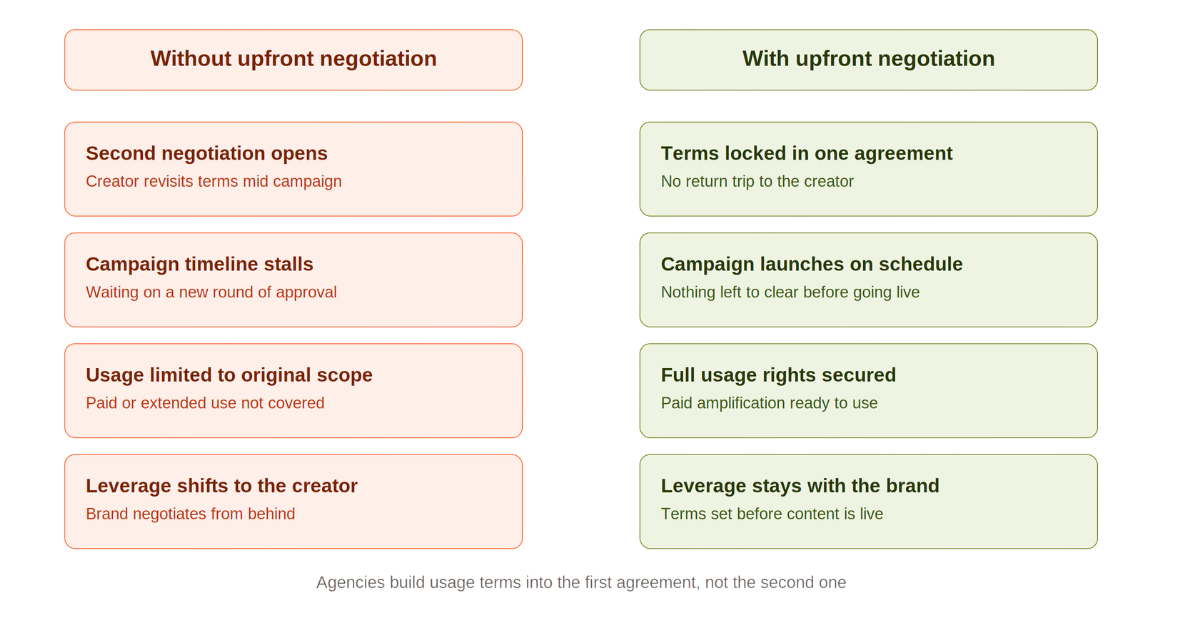
Usage rights are where brands lose the most money without realizing it. A rate that looks reasonable can balloon in cost once paid media, whitelisting, or long-term usage gets added after the fact. Creators are within their rights to charge more for expanded use, and many will do so.
An agency negotiates usage terms up front. That means paid amplification rights, extended usage windows, and cross-platform use are built into the original agreement rather than becoming a second negotiation. This single step alone can save a brand thousands of dollars per campaign.
-
Agencies Save Time and Resources
Negotiation takes time. It takes back-and-forth emails, contract review, and a working knowledge of what is standard versus what is a red flag. Internal marketing teams already carry full workloads. Adding creator negotiation to that list slows everything down.
Agencies handle this as their core function. They manage outreach, negotiation, contracts, and delivery timelines so internal teams can stay focused on strategy and execution. The result is a faster process with fewer costly mistakes.
-
Agencies Manage the Relationship Long Term
Negotiation does not end when the contract is signed. Deliverable revisions, timeline changes, and approval rounds all require ongoing communication with the creator. Agencies manage that relationship from start to finish, which keeps the process moving and protects the brand from miscommunication that can derail a campaign.
This ongoing management also sets up future campaigns. A creator who had a smooth, professional experience is more likely to offer favorable terms the next time around. Agencies build those long-term relationships across many brands, which strengthens the negotiating position for everyone involved.
Where This Leaves Brands
The creator economy is only getting more competitive. Rates are rising, usage expectations are expanding, and the creators worth partnering with have more leverage than ever. Brands negotiating without market context are working at a disadvantage before the conversation even starts.
Working with an agency changes that position. It puts experience, relationships, and market data on the brand's side of the table instead of leaving them to figure it out deal by deal.
Ready to negotiate from a position of strength? Book a meeting with our team, and let's build a creator strategy that works in your favor.